Tim’s Take
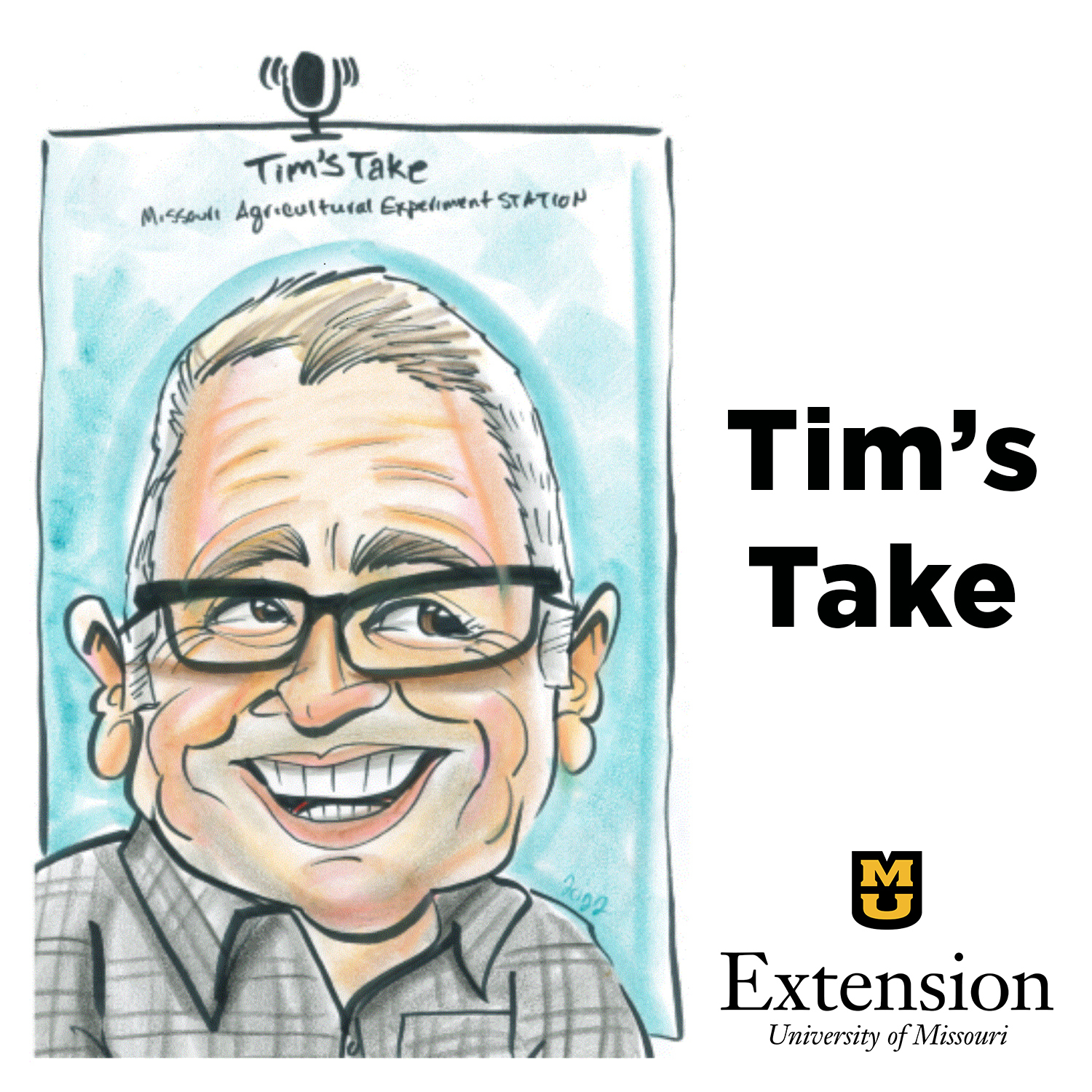
This is the monthly agricultural research podcast for the Missouri Agricultural Experiment Station (MOAES). MOAES extends CAFNR research to nearly 14,000 acres across the state to meet regional research and demonstration needs of agricultural producers and natural resource managers. Tim Reinbott is a Director of Operations at MU Extension.




Episodes
Episodes
Jul 3, 2026
Jul 3, 2026
46 min
In this episode of Tim’s Take, host Tim Reinbott sits down with Missouri State Climatologist and Extension Specialist Dr. Zach Leasor for an in-depth conversation about climate patterns, weather forecasting, and what Missouri producers can expect in the months ahead.
Recorded in mid-June, this discussion explores how warming Pacific Ocean temperatures influence the jet stream, rainfall patterns, and growing conditions across the Central United States. Dr. Leasor explains the science behind El Niño and La Niña, including what defines a “Super El Niño” and why even small changes in ocean temperatures can have major effects on weather and agriculture.
The conversation also examines how weather forecasts are developed, why predicting future conditions is so challenging, and the key differences between weather forecasting and climate prediction. Listeners will gain insight into the tools scientists use to monitor conditions and help farmers, researchers, and decision-makers prepare for the future.
Missouri Mesonet: http://agebb.missouri.edu/weather/stations/
About Missouri Agricultural Experiment Station (MOAES)The Missouri Agricultural Experiment Station (MOAES) at the University of Missouri delivers research-based solutions that improve the quality of life for Missourians and beyond. Through a network of research centers across the state, including SWREEC, MOAES supports innovation in agriculture, natural resources, and community development.
Learn more: https://moaes.missouri.edu.
Jun 5, 2026
Jun 5, 2026
48 min
In this episode, we explore the fascinating world of bees beyond the familiar honeybee. Most bees are solitary, meaning each female builds and provisions her own nest rather than living in a hive. These bees often nest underground or in natural cavities and show remarkable diversity in behavior, habitat preferences, and plant relationships.
#TimsTake #pollinators #MUAg #bees #pollinatorsareimportant #AgShorts #MissouriFarms
Learn more about MU research at the Missouri Agricultural Experiment Station website: https://moaes.missouri.edu/
#mizzou #moaes #soybean #farming #corn
The Missouri Agricultural Experiment Station (MOAES) extends CAFNR research to nearly 14,000 acres across the state to meet regional research and demonstration needs of agricultural producers and natural resource managers. MOAES has a storied history of major impacts in advancing science in agriculture, food and natural resources — locally, nationally and globally. These CAFNR laboratories provide research faculty with a wide variety of real-world conditions to test and develop strategies for agricultural production based on the geographical and climatic differences of our diverse state.
May 8, 2026
May 8, 2026
52 min
Host Tim Reinbott sits down with Andrew Kientzy of MU Extension Ag Business & Policy to break down record-high feeder prices, rising costs, and how enterprise budgets help producers evaluate real-world profitability.
Andrew Kientzy#2xAg2030
MU Extension Crop and Livestock Enterprise Budgets: http://muext.us/MissouriAgBudgets
#TimsTake #CattleEconomics #MUAg #BeefIndustry #FarmManagement #AgShorts #MissouriFarms
Learn more about MU research at the Missouri Agricultural Experiment Station website: https://moaes.missouri.edu/
#mizzou #moaes #soybean #farming #corn
The Missouri Agricultural Experiment Station (MOAES) extends CAFNR research to nearly 14,000 acres across the state to meet regional research and demonstration needs of agricultural producers and natural resource managers. MOAES has a storied history of major impacts in advancing science in agriculture, food and natural resources — locally, nationally and globally. These CAFNR laboratories provide research faculty with a wide variety of real-world conditions to test and develop strategies for agricultural production based on the geographical and climatic differences of our diverse state.
Apr 24, 2026
Apr 24, 2026
23 min
Are fungicides really delivering a return when margins are tight? University of Missouri plant pathologist Dr. Mandy Bish breaks down corn disease identification, fungicide timing, and why knowing whether you’re fighting a fungus or a look‑alike can make the difference between protecting yield and wasting dollars.
Tim’s Take 48, Part 1: Corn disease identification and fungicide timing with Dr. Mandy Bish (YouTube video)https://youtu.be/9Hw5UYx7P0cTim’s Take 48, Part 2: Soybean and wheat disease management, fungicide ROI, and on-farm research with Dr. Mandy Bish (YouTube video)https://youtu.be/WmVREDrjB7Q
Learn more about MU research at the Missouri Agricultural Experiment Station website: https://moaes.missouri.edu/
#mizzou #moaes #soybean #farming #corn
The Missouri Agricultural Experiment Station (MOAES) extends CAFNR research to nearly 14,000 acres across the state to meet regional research and demonstration needs of agricultural producers and natural resource managers. MOAES has a storied history of major impacts in advancing science in agriculture, food and natural resources — locally, nationally and globally. These CAFNR laboratories provide research faculty with a wide variety of real-world conditions to test and develop strategies for agricultural production based on the geographical and climatic differences of our diverse state.
Apr 3, 2026
Apr 3, 2026
51 min
In this special episode of Tim’s Take, host Tim Reinbott sits down with Professor Kevin Bradley, State Weed Scientist & Education Director – Extension PST in the Division of Plant Science & Technology at the University of Missouri, for an in‑depth conversation about the future of weed management and what growers can expect in the 2025 season and beyond.
Together, Tim and Dr. Bradley explore the rapidly evolving landscape of weed control—covering emerging weed pressures, updated management strategies, herbicide challenges, and the key considerations farmers should be preparing for as the next growing season approaches. The discussion then moves into the cutting‑edge technologies reshaping agriculture, from agricultural drones to autonomous robotic weed‑zapping systems and other innovative precision‑control tools.
Packed with practical insights, expert analysis, and forward‑looking perspectives, this episode offers valuable guidance for farmers, agronomists, students, and anyone interested in the future of weed science and Ag technology.
Visit the Missouri Agricultural Experiment Station (MOAES) website to learn more:
https://moaes.missouri.edu/ (Link leads to the official MU resource site.)
#mizzou #PlantNutrition #soilhealth #nutrientmanagement #CropHealth #AgScience
The Missouri Agricultural Experiment Station (MOAES) extends CAFNR research to nearly 14,000 acres across the state to meet regional research and demonstration needs of agricultural producers and natural resource managers. MOAES has a storied history of major impacts in advancing science in agriculture, food and natural resources — locally, nationally and globally. These CAFNR laboratories provide research faculty with a wide variety of real-world conditions to test and develop strategies for agricultural production based on the geographical and climatic differences of our diverse state.
Feb 6, 2026
Feb 6, 2026
55 min
Are hazelnuts the next big specialty crop for the Midwest and East Coast? In this episode of Tim’s Take, we sit down with Dr. Ron Revord (University of Missouri) and Dr. Tom Molnar (Rutgers University) to discuss the cutting-edge research behind hybrid hazelnuts. From chocolate and confections to orchards and agroforestry systems, discover what makes hazelnuts unique, how they flower in winter, and why quality and freshness are changing the hazelnut game.
In the second half of Episode 45 of Tim’s Take, hazelnut experts Dr. Ron Revord, Director of the Center for Agroforestry, and Dr. Tom Molnar, Associate Professor of Biological Sciences at Rutgers University, discuss key factors that influence hazelnut orchard success. Host Tim Reinbott continues the conversation with Dr. Revord and Dr. Molnar, focusing on research-based guidance for hazelnut production. Topics include orchard establishment, site and soil considerations, cultivar selection, pollination strategies, and long-term management for sustained productivity.
Additional information on hazelnut research, cultivar development, and production recommendations is available through the following Extension and research resources:
Rutgers University Hazelnuts Research Program https://research.rutgers.edu/agricultural-products/hazelnuts
University of Missouri Center for Agroforestry – Hazelnut Resources https://centerforagroforestry.org/working-to-build-a-hazelnut-industry-for-family-farms-across-the-midwestern-and-eastern-us/
Episode 45 Podcast YouTube Video Part One: https://youtu.be/-_39VL5yrVA
Episode 45 Podcast YouTube Video Part Two: https://youtu.be/vQ6Um_lb144
Learn more about the Missouri Agricultural Experiment Station (MOAES) and its research programs: Missouri Agricultural Experiment Station official website https://moaes.missouri.edu/
#Mizzou #PlantNutrition #Hazelnuts #CropHealth #AgScience #AgriculturalResearch
Jan 2, 2026
Jan 2, 2026
54 min
In this episode of Tim’s Take, host William Lee sits down with longtime University of Missouri agronomist Tim Rienbott, Director of Communications, Assistant Director of Natural Resources, and Director of Sanborn Field. With over 40 years of experience in agronomy, cover crops, and soil management, Tim brings a lifetime of insight to this deep-dive conversation.
Together, William and Tim explore the fundamentals of cover crops—what they are, why they work, and how farmers can successfully integrate them into real cropping systems. Tim shares stories from his earliest days researching legumes in the late 1980s, how drone and broadcasting technology has changed cover-crop seeding, and why soil protection remains the #1 reason to use cover crops.
Part One YouTube Video: https://youtu.be/4r8aWYLEQBo
Part Two YouTube Video: https://youtu.be/tvJzIY8DFos
Visit https://moaes.missouri.edu/ to learn more.
#mizzou #covercrops #farming
The Missouri Agricultural Experiment Station (MOAES) extends CAFNR research to nearly 14,000 acres across the state to meet regional research and demonstration needs of agricultural producers and natural resource managers. MOAES has a storied history of major impacts in advancing science in agriculture, food and natural resources — locally, nationally and globally. These CAFNR laboratories provide research faculty with a wide variety of real-world conditions to test and develop strategies for agricultural production based on the geographical and climatic differences of our diverse state.
Dec 5, 2025
Dec 5, 2025
51 min
As winter sets in, feeding efficiency becomes critical for maintaining healthy, productive herds — and for keeping feed costs under control. In this episode of Tim’s Take, we discussion with Dr. Eric Bailey, State Beef Nutrition Specialist with the University of Missouri Extension, as he breaks down how to reduce hay waste and improve your feeding strategies. From the impact of late-season droughts to practical feeding methods like unrolling hay and feeding one day at a time, Dr. Bailey explains how a few simple management changes can make a big difference in both efficiency and cost.
Visit https://moaes.missouri.edu/ to learn more.
#mizzou #cattle #farming
The Missouri Agricultural Experiment Station (MOAES) extends CAFNR research to nearly 14,000 acres across the state to meet regional research and demonstration needs of agricultural producers and natural resource managers. MOAES has a storied history of major impacts in advancing science in agriculture, food and natural resources — locally, nationally and globally. These CAFNR laboratories provide research faculty with a wide variety of real-world conditions to test and develop strategies for agricultural production based on the geographical and climatic differences of our diverse state.

Missouri Agricultural Experiment Station
Missouri Agricultural Experiment Station (MOAES) has a storied history of major impacts in advancing science in agriculture, food and natural resources — locally, nationally and globally.
These CAFNR laboratories provide research faculty with a wide variety of real-world conditions to test and develop strategies for agricultural production, based on the geographical and climatic differences of our diverse state.